Fifty years ago this year, Boston finished the tallest building in New England — and the only skyscraper this city has ever learned to love. That affection was not the plan. The Hancock Tower opened five years late, at roughly double its budget, after cracking the masterpiece next door and shedding its own windows onto Copley Square. Half a century later, Bostonians defend it like a landmark. The reason says more about how this city assigns value than any market report I could write.
Consider what stood on that ground in 1968, when the excavation began. Trinity Church, H.H. Richardson’s masterwork, consecrated in 1877, the building that gave American architecture its own Romanesque and made Copley Square the most serious architectural room in the country, with McKim’s Boston Public Library facing it across the plaza. Into that ensemble, an insurance company proposed a 790-foot mirror.
Then the ground gave way. The temporary retaining walls around the excavation warped, the Back Bay fill moved, and the settlement sent a spray of cracks up through Trinity’s stone walls. The parish sued in January 1975. The case ran twelve years, through the Supreme Judicial Court, and the church won, a $4.1 million judgment affirmed in 1987, closer to $11 million once a decade of interest was counted.
The tower, meanwhile, was failing in public. Its 500-pound glass panels began detaching and falling, from any height, up to the full sixty stories, and for years, plywood covered acres of the facade while the city watched and named the building accordingly. Engineers then found that the tower swayed enough to sicken its upper-floor tenants, and, more alarmingly, that under certain winds it could have toppled onto its narrow side. Two 300-ton dampers went into the 58th floor. Some 1,500 tons of diagonal steel went into the frame. More than ten thousand panels were eventually replaced. By opening day in September 1976, the Hancock was the most public embarrassment in American architecture.
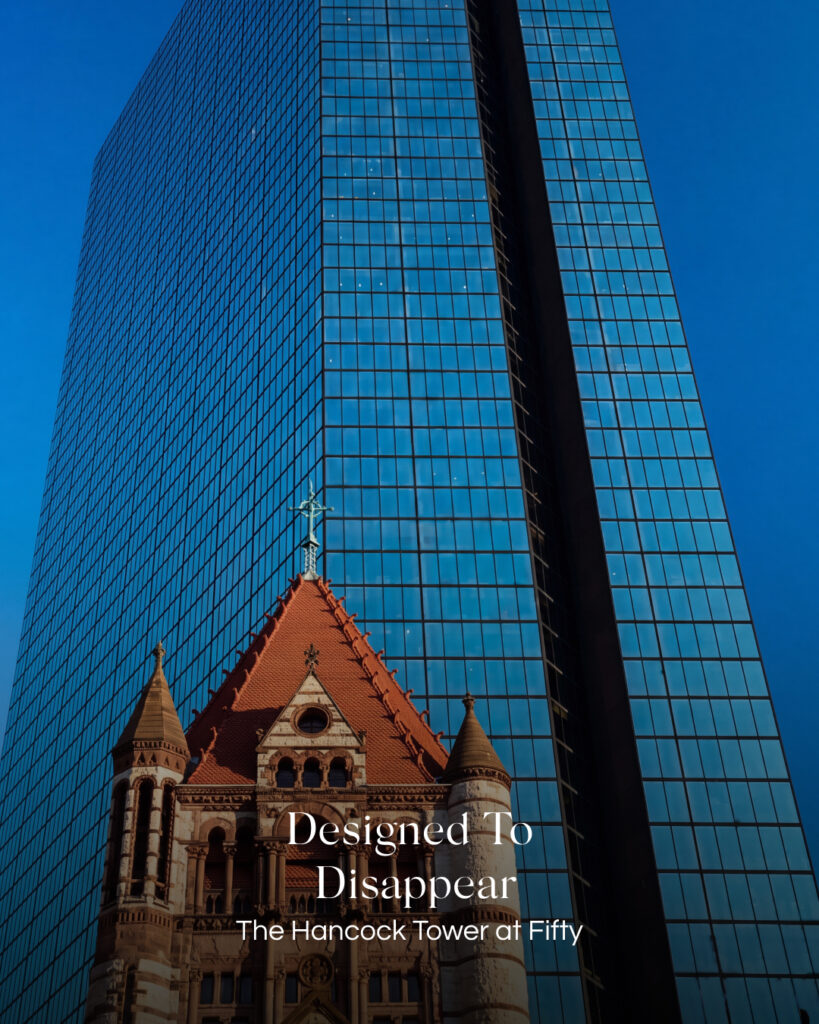
None of that touched the idea, and the idea is why the building survived its own construction. Henry Cobb, of I.M. Pei & Partners, had designed a sixty-story building intended to give up its own presence. A thin parallelogram rather than a box, so the corners read as blades and the mass reads as a plane. The largest glass panes possible, no spandrels, mullions cut to almost nothing, a surface with no visible structure to look at. Reflective glass tinted faintly blue, so that on a clear day the tower barely separates from the sky behind it.
And the placement was the argument. Cobb set the tower at an angle, its short side toward Copley Square, so that the building would impose as little of itself as possible on the square. What you actually see from the steps of Trinity is sky, cloud, and the church itself, doubled in the best curtain wall ever built in this city. Sixty stories of 1976 spend every clear morning pointing at 1877.
The profession understood before the public did. The AIA gave the building its National Honor Award in 1977, while the lawsuit was still young, and its Twenty-five Year Award in 2011. But the better verdict came from Boston. In 1994, a Globe poll of architects and historians ranked the Hancock the third-best work of architecture in the city, behind Trinity Church and the Boston Public Library. The tower placed immediately behind the church it had cracked. In any other city that would read as irony. Here it reads as the system working: the new building earned its standing by making the old ones look better.
I have spent twenty years selling homes in the neighborhoods that surround that tower, and the Hancock’s lesson prices itself into the market daily. Boston does not reward new construction for announcing itself. It rewards new construction for knowing where it is. The most valuable contemporary residences in this city, the glass at One Dalton, the towers rising over the Common, sell, above all, their orientation toward old Boston: the Public Garden out the window, Trinity’s roofline at eye level, the State House dome holding the view. The glass is priced by what it faces.
Sellers of period properties should read the same lesson from the other side. The Hancock’s deference is a fifty-year-old, sixty-story argument that the 1877 building is the asset. Every reflective tower that has gone up since has, in effect, agreed, each one borrowing its views, and its values, from the streets that were already here.
Fifty years on, the tallest building in New England still does the one thing Boston asked of it. It gives the view back.