Every July, a lawn above the Atlantic in Beverly fills with automobiles that have outlived their makers, their first owners, and in several cases the companies that built them. The Misselwood Concours d’Elegance judges them on two questions: how faithful the car remains to what its maker intended, and how well the decades of ownership since have treated it. The collector-car world settled on that standard generations ago. Boston’s housing market is arriving at the same one now. and pricing accordingly.
The concours d’élégance began with the Parisian aristocracy, who paraded their carriages through the city’s parks and judged coachwork, finish, and the evidence of care. When the automobile arrived, the format simply changed vehicles. Misselwood is the tradition’s New England address, a neck of coastline once called Boston’s Gold Coast, purchased by Patrick Tracy Jackson in 1845, held by the Cabots and the Agassiz family, kept today by Endicott College. Cars arrive from across the country to be judged on ground that was itself built, held, and handed down.
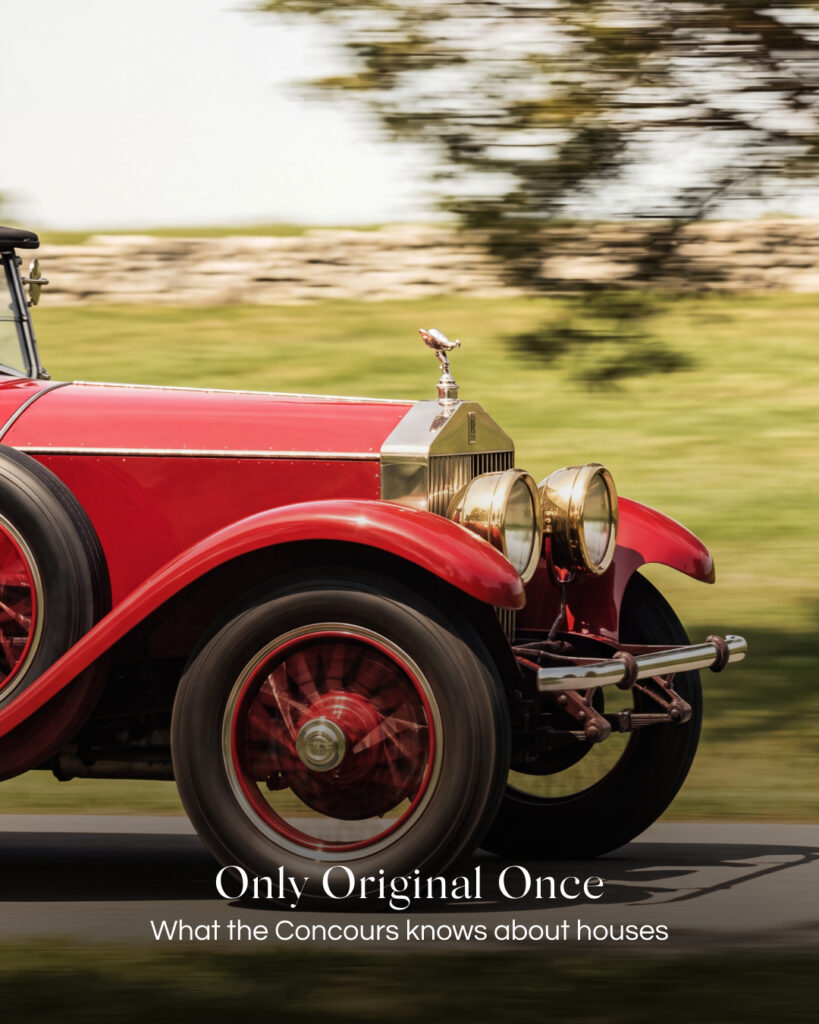
Last summer’s Best of Show made the argument local. A 1921 Rolls-Royce Silver Ghost Phaeton, built in Springfield, Massachusetts, the only place Rolls-Royce ever manufactured cars outside Britain, where 2,946 automobiles were produced before the Depression closed the factory in 1931.
The winning car is the oldest Springfield production car known to survive, wearing its original body on a matching-numbers chassis. It was restored in 2016, and the distinction matters. The restoration recovered its condition. The award recognized what no shop can supply, original substance from the first year of the line, a hundred miles from the factory floor where it was made.
In August 2024, the Pebble Beach Concours, the most prestigious event of its kind, gave Best of Show to a 1934 Bugatti Type 59 shown unrestored: the paint aged, the wear honest, more than eighty years essentially untouched. In seventy-three runnings, the top award had always gone to cars brought back to showroom perfection. Collectors have a maxim for what changed: a car is only original once.
Read the two winners together and the hierarchy becomes clear. A faithful restoration built on surviving original substance earns the lawn at Misselwood. Untouched originality now takes the highest lawn in the sport.
On the Greater Boston closing sheet published July 1, two period Colonials led the list: a 1913 house on Worthington Road in Brookline at $10 million, and an 1855 house on Ivy Street at $8.65 million. The newest Colonial on the same sheet, built in 2018, nearly the same size as the 1855 house, traded at $4.8 million.
Nearly every period house in Boston has been touched. The question the market asks is the Misselwood question: how much of the original came through. In twenty years of walking buyers through period houses, I’ve watched them learn to read a stair hall the way a concours judge reads an engine bay. They are looking for what survived.
The cars leave the lawn at Misselwood on Sunday evening. The standard they were judged by applies every day of the year, to anything built once and worth keeping.