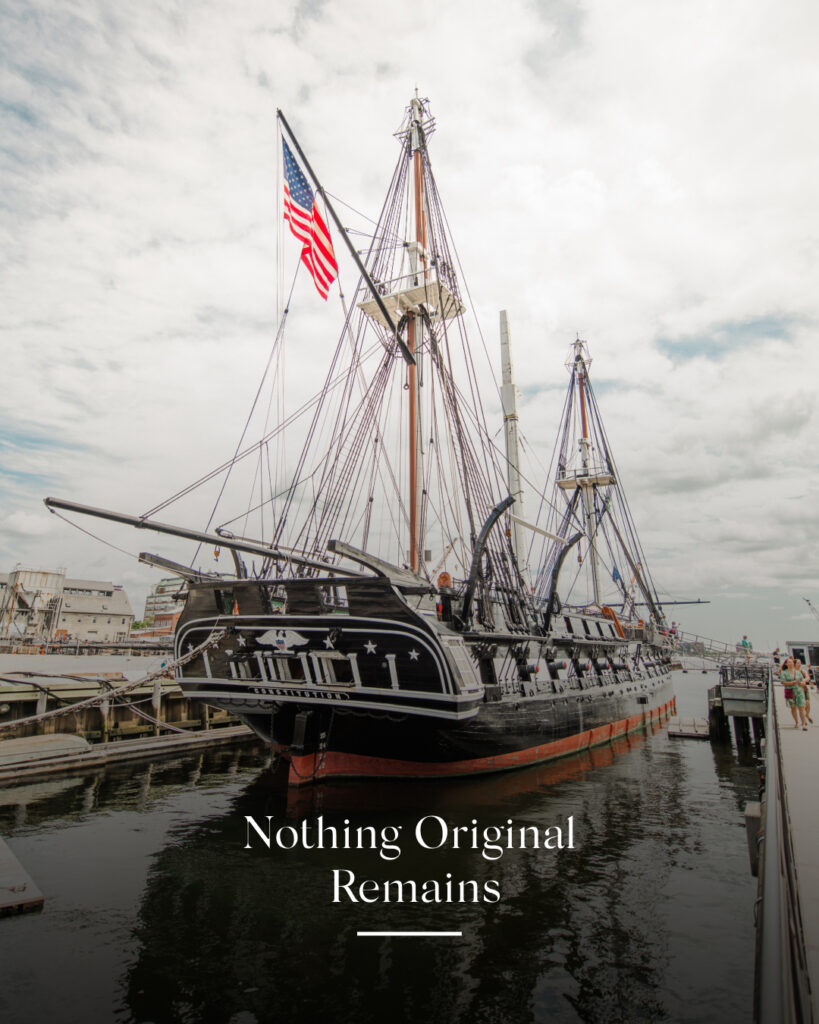
When the Sail250 fleet enters Boston Harbor next month, more than fifty tall ships will draw the crowds. The one most worth a visit is the one that was already here. The USS Constitution has been docked in Charlestown since 1797 and is the oldest commissioned warship afloat anywhere in the world.
By the Navy’s own estimate, only eight to ten percent of the ship’s original 1797 material is still aboard. Two centuries of salt, weather, and war meant the rest was replaced, plank by plank, across generations of restoration. And yet no one who walks her deck calls her a replica. She is, unmistakably, Old Ironsides.
She is a shining example that contradicts what most people believe about old things.
If you replace every plank of a ship over time, is it still the same ship? The Navy believes so, and they have been caring for her for over 200 years.
Every twenty years or so, she is hauled into dry dock and made whole again. White oak is set aside decades in advance for the purpose. The work is continuous, deliberate, and largely invisible to the people who admire the result.
What persists is not the material. It is the stewardship. The Constitution is still original because the line of people refusing to let it go was never broken. This is a deeply Bostonian idea. The city has always understood that permanence is something you maintain, not something you inherit and leave alone.
The same logic governs the buildings that command the highest prices in this city. A brownstone on Commonwealth Avenue dates to the 1860s. But the version that sells today is not the building as it stood then. The systems have been replaced. The kitchens have been reimagined more than once. Windows, roofs, mechanicals, finishes, all renewed across generations of owners. What makes it one of the best addresses in Boston is not that it was frozen in 1865. It is that it was never abandoned.
For decades, buyers spoke about historic homes as though value lived in the untouched. As my recent trip to Italy reminds me, this is a philosophy that Italians have leaned into for hundreds of years. The most discerning buyers in Boston understand that a period home that has been continuously, intelligently cared for is worth more than one preserved as a museum piece, and more than one gutted into anonymity. The value is a direct reflection of the chain of custody, the evidence that someone competent has been paying attention all along.
There is a keel beneath the Constitution that has never been replaced. The lowest frames, the bottom planks, original to 1797 and still doing their work. Every great old house has its equivalent, the load-bearing materials that stay while everything around is renewed.
This reframes what a buyer is actually acquiring when they purchase a historic property. It is an obligation, the next link in a chain of maintenance that began long before them and, if they choose well, continues long after.
That is not a burden. It is the entire point. The homes that hold their value across cycles are the ones whose owners understood that provenance is not a plaque on the wall. It is a practice. The work is never finished, and the value comes precisely from the fact that, for two centuries, no one let it lapse.
The visiting fleet will sail out again in a week. The Constitution will stay, because someone is always already planning her next restoration. That is what creates an everlasting legacy.
Find the next home that calls to you as a custodian here.