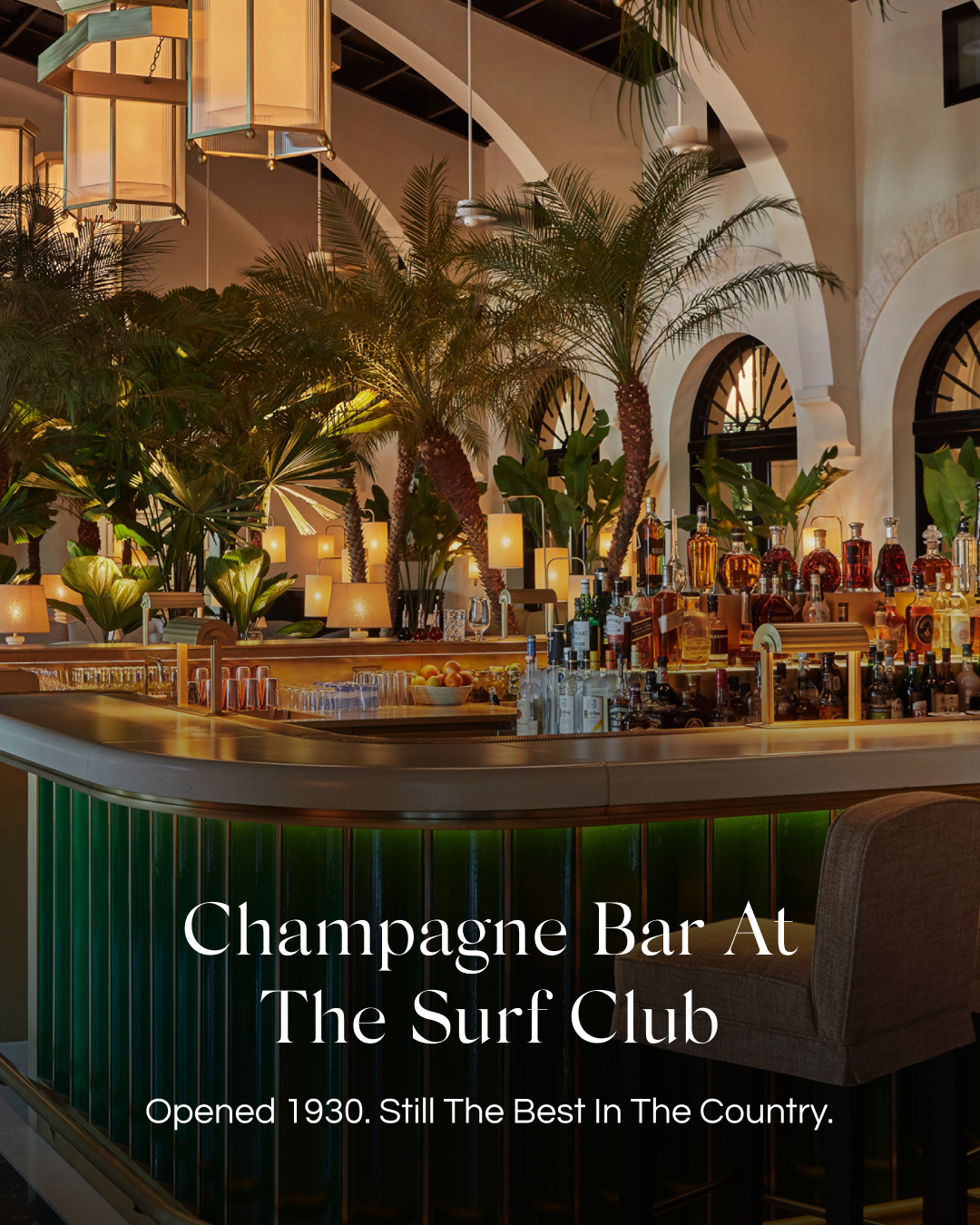
Food & Wine just named the Champagne Bar at the Four Seasons Surf Club the best hotel bar in America. I wasn’t surprised. The Surf Club is where I stay every time I’m in Miami, and that bar is a big part of why.
It beat Bemelmans at The Carlyle. It beat the Carousel Bar at the Hotel Monteleone. On paper, those are institutions. In practice, the Surf Club deserved it.
What all three have in common is the one thing you can’t manufacture: age. The Surf Club opened in 1930. Bemelmans in 1947. The Monteleone has been running since 1886. None of them were designed to win awards. They were designed to work — to hold a room, to anchor a neighborhood, to give a city somewhere to be itself. The recognition came later, as a kind of confirmation of what everyone already knew.
You can open a hotel today with a Pritzker architect, a celebrated bar program, and a press strategy built for launch week. Eighteen months later it can be beautiful and completely forgettable. What it cannot be is old. Provenance is the one thing money can’t accelerate.
This is not a hospitality observation. It’s a real estate one.
Every year, the supply of pre-1950 buildings shrinks. Some are lost to development. Some are renovated into anonymity. The ones that survive, and are cared for properly, become scarcer. Meanwhile the pool of buyers who want them keeps growing. That math only resolves one way.
Boston is one of the best places in the country to understand this. The brownstones on Commonwealth Avenue date to the 1860s. The rowhouses on Beacon Hill are older. The buildings that command the highest prices in this city are, almost without exception, the ones that were already considered the best addresses a hundred years ago. That’s not nostalgia. It’s the market confirming something it has confirmed for generations.
New construction here is strong. Some of it is genuinely exceptional. But at the top of the market, buyers aren’t just purchasing square footage or finishes. They’re purchasing permanence. A building that has been one of the best addresses in Boston since 1890 will almost certainly still be one of the best in 2050. That kind of durability is rare, and the market prices it accordingly.
The Champagne Bar didn’t win because it was the most innovative bar in the country. It won because after 96 years, it was still exactly what it was meant to be. The award is new. The reason for it isn’t.