Most people walk past trees without thinking about what they’re doing. Shade, sure. A pleasant canopy of green in summer. But trees in a city like Boston are performing work that goes far beyond aesthetics, shaping temperature, walkability, air quality, and the lived texture of a street. The City of Boston’s latest Tree Canopy Assessment confirms something that careful observers have sensed for years: the city is getting greener, and it’s happening by design.
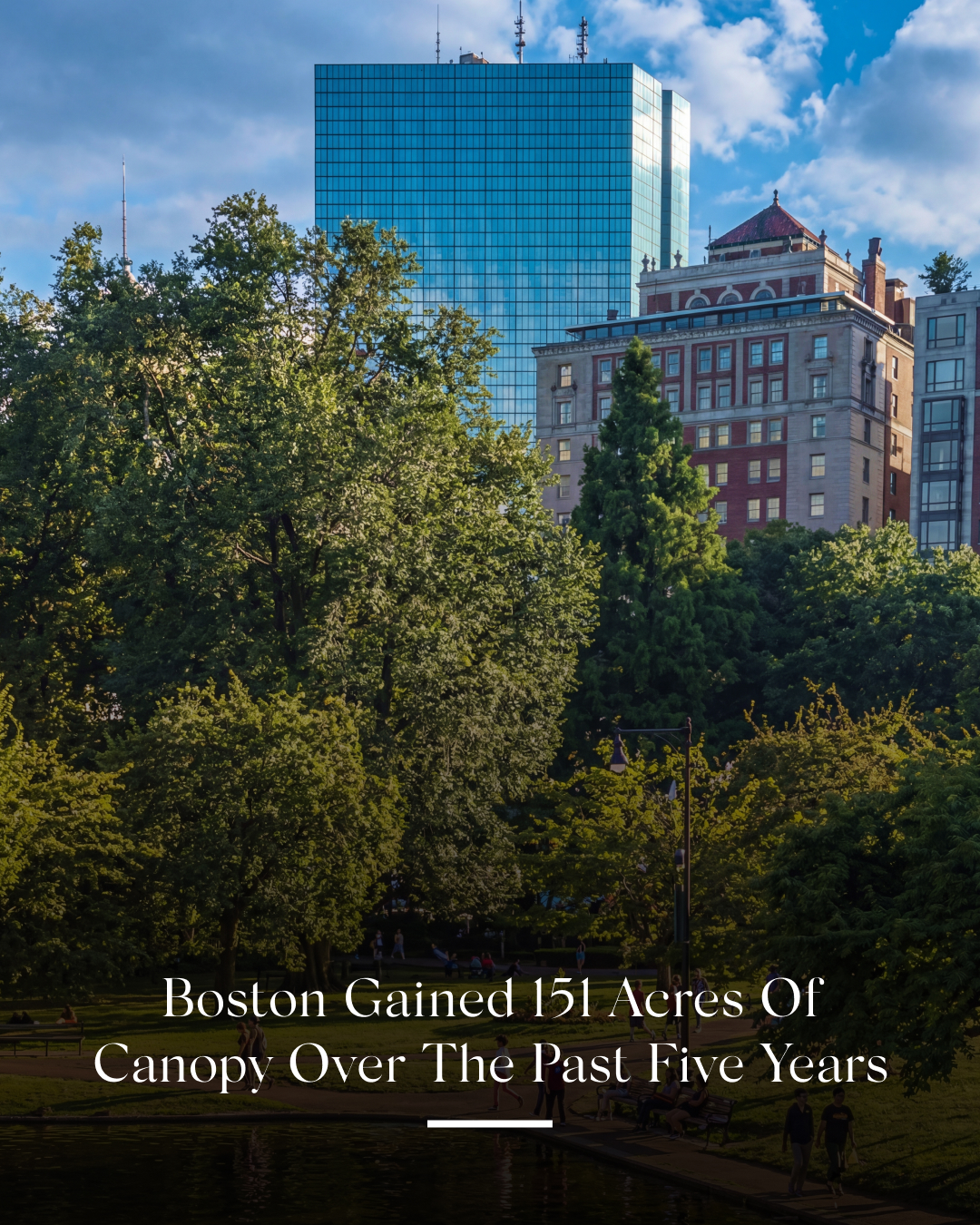
Between 2019 and 2024, Boston added a net 151 acres of tree canopy, roughly the equivalent of 114 football fields. Total canopy coverage now stands at 28.5%, up from a period of stagnation where the previous five years produced no net change at all. The gains were concentrated on public land: parks, rights-of-way, and streetscapes where the city has made deliberate investments in planting and maintenance.
This is not a story about landscaping. It’s a story about infrastructure.
Boston has been thinking about trees as civic architecture for nearly 150 years. Frederick Law Olmsted’s Emerald Necklace, a seven-mile chain of parks and parkways stretching from the Common to Franklin Park, was one of the nation’s earliest examples of green infrastructure. Olmsted didn’t design parks for decoration. He designed them to solve problems: sanitation, drainage, public health, and the psychological toll of density. The parks were engineered to look natural, but every contour and sight line was deliberate.
What’s striking about the 2026 canopy data is how neatly it extends that legacy. The largest gains in tree cover came from rights-of-way, the streets and sidewalks where trees meet daily life. Boston’s Urban Forestry Division nearly tripled its canopy growth on rights-of-way compared to the prior assessment period, adding 67 acres of coverage through targeted planting and care. Parks added another 104 acres. The city isn’t just preserving green space. It’s expanding it, in the places where it matters most.
For decades, the real estate industry treated trees the way it treated wallpaper: nice to have, rarely a deciding factor. That calculus has shifted. Research consistently shows that neighborhood tree canopy — not just the trees on a property, but the green coverage within a few hundred meters — has a measurable effect on property values. One national meta-analysis of hedonic pricing studies found that homes in areas with higher-than-median canopy coverage commanded premiums of 4–6%, with the effect strongest in established urban neighborhoods.
The mechanism isn’t mysterious. Trees reduce surface temperatures, improve walkability, lower energy costs, and create the kind of street-level experience that makes a neighborhood feel resolved rather than raw. In a city where summer heat islands can push temperatures 7 degrees higher in concrete-heavy neighborhoods than in tree-lined ones, canopy coverage is a proxy for livability. And livability, as any discerning buyer understands, is the foundation of lasting value.
The assessment’s neighborhood-level data tells a more nuanced story. Jamaica Plain led the city in raw canopy growth, adding 21 acres and reaching 45% tree coverage, nearly double the citywide average. East Boston, South Boston, and West Roxbury also posted significant gains. These are neighborhoods where public investment in parks and street trees is compounding over time, creating the kind of layered, mature landscape that takes decades to develop.
Meanwhile, residential land, which accounts for 35% of Boston’s total tree canopy, saw a net loss of 116 acres. That tension between public gains and private losses is worth paying attention to. It suggests that while the city is doing its part, individual property decisions are trending in the other direction. Construction, clearing, and the economics of development continue to erode canopy on private land, even as the public realm grows greener.
For buyers evaluating neighborhoods, this creates a useful lens. The neighborhoods investing in their tree canopy today are building a form of value that won’t show up on a spec sheet but will shape how a street feels in ten years. It’s the difference between a block that gets warmer each summer and one that gets cooler.
In the luxury market, where buyers are increasingly design-literate and environmentally attuned, this matters. The most thoughtful buyers aren’t just evaluating a property’s interior. They’re evaluating the street, the light, the walk to the park, the temperature on the terrace in August. They’re reading the landscape the way they’d read an architect’s intent — looking for evidence of care, foresight, and long-term thinking.
Boston’s tree canopy isn’t decoration. It’s the kind of asset that compounds quietly, improves with age, and rewards the people who paid attention early. Olmsted understood that in 1878. The data confirms it in 2026.