For decades, luxury real estate relied on staging to tell a story. Neutral furniture. Safe art. Carefully placed objects designed to offend no one and appeal to everyone.
It works. But it’s also temporary, generic, and ultimately transactional.
As the luxury market matures, especially among experienced, design-literate buyers, staging is starting to feel like what it is: a short-term illusion. The next era of high-end living is moving away from set dressing and toward something far more enduring.
Art is becoming infrastructure.
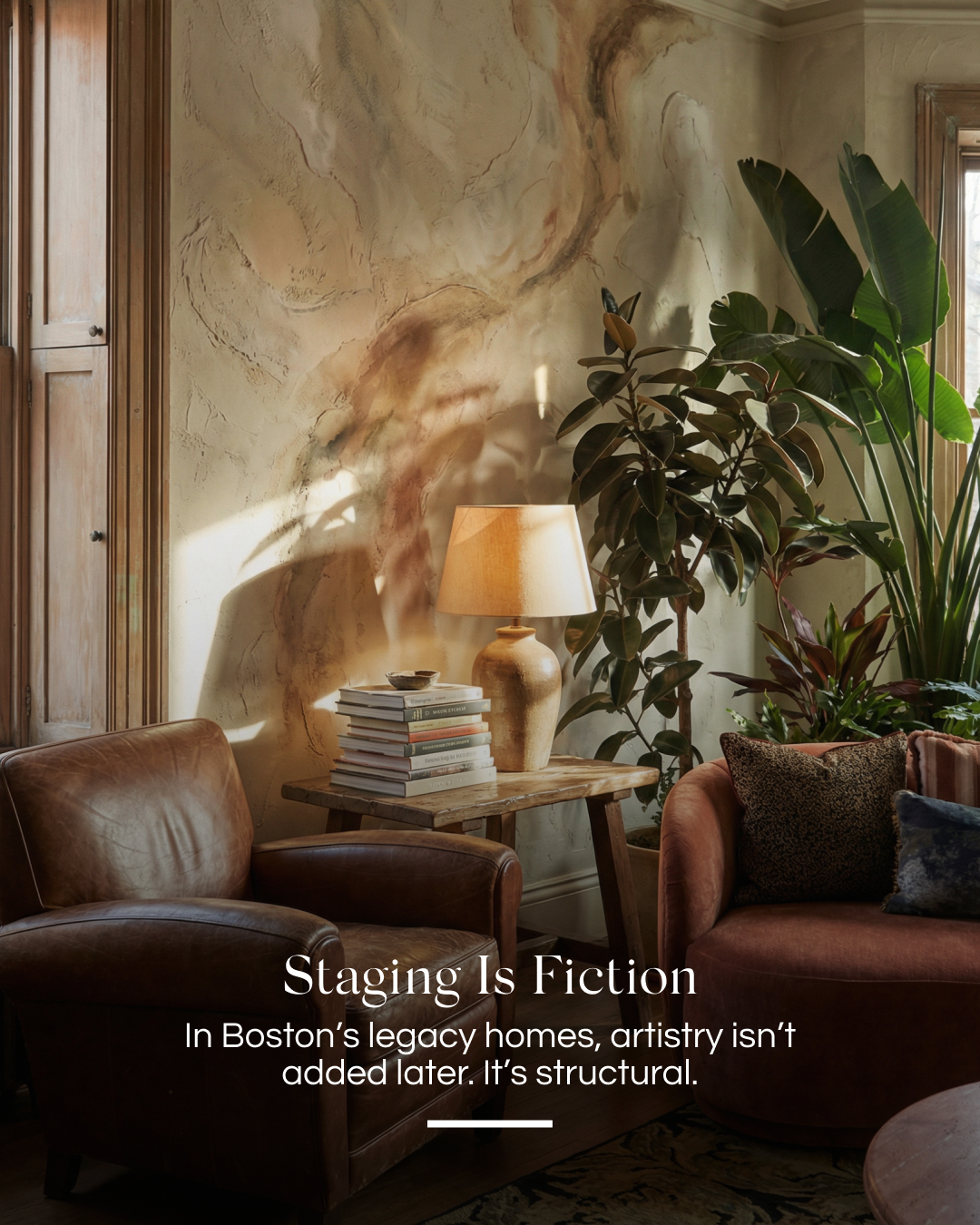
Walk into the Ames-Webster House or the Pierce House and you don’t see neutral palettes designed for resale.
You see a dialogue between the architect and the artisan.
The art wasn’t hung on the wall after the fact. The wall was the art.
Staging exists to be removed. Art, when treated seriously, does the opposite. It anchors a home. It defines it.
In the homes that hold long-term value, culturally and financially, art is no longer an accessory. It’s embedded into the architecture itself. Commissioned murals. Site-specific sculpture. Restored historic details that were never meant to be swapped out with trends.
These elements aren’t there to help a property sell. They’re there because the home wouldn’t make sense without them.
That distinction matters.
Luxury buyers today are increasingly uninterested in spaces that feel interchangeable. They’re looking for residences that are specific, intentional, and difficult to replicate. Homes with a point of view.
When art is infrastructural, it changes how a home is experienced.
A commissioned mural isn’t decoration. It’s a decision. It shapes how light moves through a space. It becomes part of the daily rhythm of the home.
A sculpture designed for a courtyard or garden isn’t staging. It’s orientation. It gives the property a center of gravity.
Even architectural restoration functions this way. Preserved plasterwork, original fireplaces, hand-carved staircases, these aren’t nostalgic gestures. They are irreplaceable assets that connect a home to its past while grounding it in permanence.
Unlike furniture or surface finishes, these elements cannot be replicated overnight. That scarcity is precisely the point.
This evolution mirrors a broader change in how high-net-worth buyers think about real estate.
Homes are no longer viewed solely as lifestyle statements or short-term assets. They are increasingly seen as long-term environments, places meant to age well, hold relevance, and support how people actually live.
In that context, temporary staging feels misaligned. Infrastructure feels honest.
This is especially true in Boston, where architecture carries real historical weight. Buyers here tend to value lineage, craft, and continuity. They understand the difference between something added for effect and something that belongs.
A home with embedded artistic decisions, whether historic or contemporary, signals confidence. It doesn’t need to convince. It already knows what it is.
This philosophy isn’t new, it’s deeply Bostonian.
In 1897, the city became the birthplace of America’s Arts and Crafts movement with the founding of the Society of Arts and Crafts on Newbury Street.
Its guiding principle, “Head, Hand, and Heart” rejected the soulless perfection of factory production. It argued that a home’s value lived in evidence of human touch: the hand-carved newel post, site-specific stained glass, millwork designed for one library and no other.
Staging helps a buyer imagine a life. Art, when done properly, reflects one.
The most compelling luxury homes I see today are not the most perfectly styled. They’re the ones where design choices feel inevitable rather than strategic. Where art is not there to soften a space, but to define it.
As the market continues to separate substance from surface, this distinction will only grow more important.
Because furniture can be removed. Infrastructure remains.